When your accent or foreign degree gets you treated as a risk
When an accent or a foreign credential lowers a US buyer's trust: peer notes on spotting the pattern, how foreign degrees are recognized, and what founders choose.
A founder at the IFN meetup table has spent more than a decade building products at home. They have led teams, shipped launches and sold a company. Tonight they describe a sales call from last week. The buyer had been warm over email. A few minutes into the call, once the founder started walking through the demo, the questions got shorter, and no follow-up came. A few weeks before that, a potential partner asked twice where their degree was from, as if the first answer had not counted. Someone across the table nods. The first time it happened to them, they assumed the problem was their pitch and rewrote it more than once before they saw it differently.
The room hears some version of this most months. This post is peer orientation on what founders describe when an accent or a foreign credential seems to lower the trust a US buyer, partner or investor gives them. It covers how people tell a pattern from a bad fit, how foreign degree recognition works here, and what founders choose to do about it. Hiding who you are is not part of it. It is not legal, employment or immigration advice, and it does not replace counsel.
Disclaimer
This is not legal, employment, immigration, or professional licensing advice. IFN shares what founders in the room tend to talk through. Whether a credential is accepted, whether treatment was unlawful, and what your status allows all depend on your facts. Verify with licensed professionals and official sources before you act.
What it looks like when it happens
Founders rarely describe one big moment. They describe small extra steps that add up.
One is the extra proof: a buyer asks for a second reference when a local vendor would only have needed one. Another is the meeting where the teammate or advisor who sounds local gets all the questions, even though you built the product. A third is a degree from a respected university at home that reads as unknown here, so the person across the table treats it as a blank line on your bio.
Peers are careful to separate a bad fit from a pattern. Sometimes a deal goes cold because the budget disappeared or the product did not match the need. Some calls go badly for everyone. What people watch for is repetition: the same kind of question, from the same kind of room, at the same point in the conversation. Founders who keep short, plain notes after calls say they see the picture more clearly over time than when they replay each call late at night.
Foreign degrees: who decides
This part has more structure than most people expect, though less than they would like.
The US has no single national body that recognizes foreign degrees. Whoever is asking decides. That might be an employer, a school or, for licensed professions, a state licensing board. Many of them ask for an evaluation from a private credential evaluation service, which compares your degree to a US equivalent. The US Department of Education has a page on recognition of foreign qualifications that explains how this works, and it is the official place to start reading. The room does not recommend particular evaluators. Which one fits depends on who is asking, so founders ask the requesting organization what it accepts.
Most founders selling a product never go through a formal evaluation. The degree comes up in a bio, a pitch deck or a partner's due diligence, and the real question is how much context to give. Some founders add a short line saying what the institution is and what the program covered. Others leave the degree out of sales materials and let the work carry the weight. If your field is a licensed profession, that is a separate question for the state licensing board where you want to practice.
What founders choose to do
Peers talk about these as choices. Different people make different ones, and the same person often changes their approach over time.
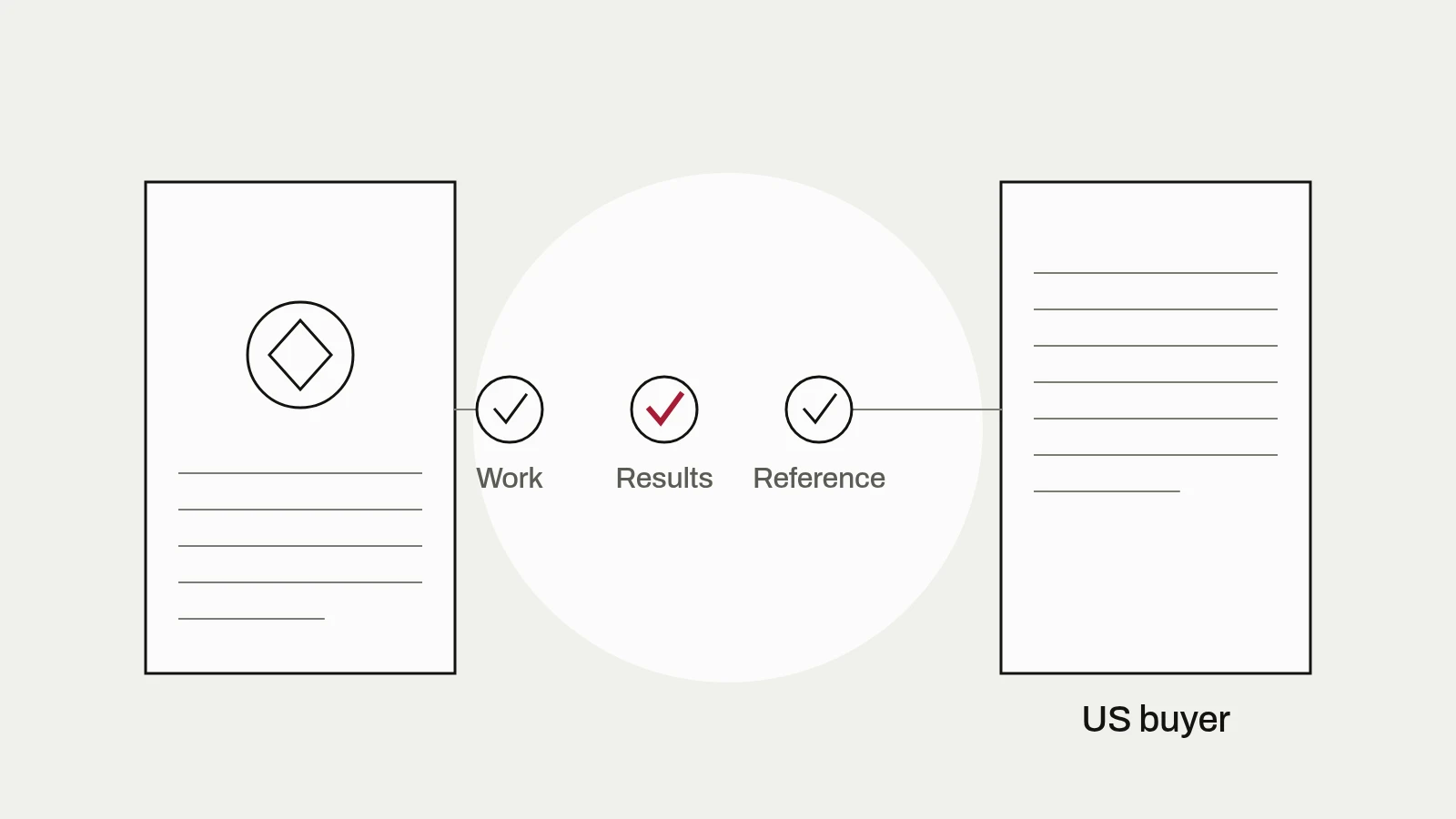
Many lead with proof a US buyer already knows how to read: shipped work, measurable results and references. A short case study with a clear outcome tends to settle doubts before anyone voices them. The go-to-market post covers the trust signals US buyers ask for in more depth.
Others bring in a US reference early. Founders who had one US customer, advisor or partner willing to vouch for them say later calls felt different. Some ask that person to join a first meeting with a new prospect.
Then there is the decision about when to name it. Some founders address it directly, with one sentence about where they built their career and what they did there. Others decide a particular meeting is not worth the energy and move on. Peers treat both as reasonable. What wears people down is deciding from scratch every single time, so some settle on a default and adjust from there.
The one that comes up most is the apology. Founders notice they open calls with "sorry, my English" and realize it frames everything that follows. Founders who stopped saying it say they felt different on calls, even when nothing else changed. The room does not trade accent-reduction tips. The accent belongs to the person who built the company.
The cost of carrying it
This part gets talked about less.
It looks like second-guessing a call afterward, rereading an email three times before sending it, or being the only person in the room who has to think about how they sound. It is a kind of tiredness that is hard to explain to people who have never had to carry it.
Part of why founders keep coming back to the meetup is that most people at the table have some version of the same story. You can skip the background and get straight to the question. Someone nearby has also been asked twice where their degree is from.
If the weight of it starts to follow you home, a licensed professional (a doctor, therapist or counselor) is the right person to talk to. Peers can listen, but they cannot do that job.
When it goes further
Some situations go well past a cold sales call. If treatment in hiring or employment, yours or your team's, starts to look like discrimination based on where someone is from, there are official channels. The US Equal Employment Opportunity Commission has a page on national origin discrimination that explains the federal side. The room does not try to decide whether something counts. That is a question for employment counsel, and the legal counsel post covers how founders find the right kind of lawyer.
When we stop talking
The room is good for recognizing patterns and comparing choices. Bring in professional help when any of these come up:
- Whether treatment in hiring or employment was unlawful discrimination: employment counsel, with the EEOC for the federal process
- Whether a foreign qualification lets you practice a licensed profession: the state licensing board for that profession in that state
- Anything about your immigration status, including what work you can do while you are here: immigration counsel
These are separate roles, and one professional rarely covers all of them.
Soft next steps
Come to the next IFN meetup with one concrete trust question: a call that went cold that you cannot read, a credential you are unsure how to present, or a moment you are still deciding whether to name. Guests are welcome; register on Luma or check dates on ifn.community. The meetup happens at Station Austin. If you want the private member channel and members-only call, Become a member. Fuller notes on building trust with US buyers and partners live with membership and the Resources hub as that catalog fills in.
Sources
- US Department of Education, Recognition of foreign qualifications
- US Equal Employment Opportunity Commission, National origin discrimination
- Station Austin, stationaustin.org