Opening an EIN and why the letter matters for banking
Why banks ask for the IRS EIN letter, where name mismatches stall applications, and how peers at IFN Austin keep the paper straight.
A familiar moment at the IFN Austin meetup: a founder scrolls back through their inbox to show the table an email with a nine-digit number in it. That's their EIN. Their business bank application has been in review for two weeks, and the bank's latest message asked for "the IRS letter." They have the number but not the letter, and they aren't sure which letter the bank means. Two people across the table nod, because the same thing held up their accounts.
This is peer orientation from that room: what an EIN is, why banks care so much about the paper behind it, and where it tends to fit in the order of things. Not a filing guide. Not tax advice.
Disclaimer
This is not legal, tax, immigration, or banking advice. IFN shares what founders in the room tend to talk through. IRS processes, letter names, and bank requirements change, and the right answer depends on your entity, your ownership, and your status. Verify with licensed professionals and official sources before you act.
What an EIN is, plainly
An Employer Identification Number is a nine-digit number the IRS assigns to a business for federal tax purposes. Plenty of companies with no employees have one, mostly because banks, payment processors, payroll providers, and larger customers ask for it before they will work with you.
The IRS explains who needs one and how to apply on its Get an Employer Identification Number page. Form SS-4 is the underlying application. The About Form SS-4 page has the current form and instructions. Peers read those directly. IRS pages change, and the source beats a forwarded screenshot.
When you have no SSN or ITIN
This is where many international founders first get stuck. The IRS online application expects the person listed as responsible for the company to have a Social Security number or ITIN, and it is only for companies whose principal place of business is in the US. A lot of people in the room had no SSN or ITIN when they formed.
The path they describe is a paper Form SS-4 sent by fax or mail, and it takes longer than the online flow. Founders whose principal place of business is outside the US also mention the IRS phone line for international applicants. The paper comes back differently too: the IRS says a fax application usually gets the number back by fax in about four business days, and mail takes about four weeks. Which channels are open, and how long each takes, changes. Peers check the IRS EIN page at the time they apply instead of relying on how someone did it last year.
Some founders hand this step to a formation service or an accountant. That can save time. Founders who go that route say one extra question up front helps: how will the IRS document itself reach you, along with the number? Founders who skipped that question often end up holding exactly what the person in the opening scene had, a number in an email.
The letter behind the number
Peers mention two documents most often.
The first is the notice the IRS issues when it assigns the number, the CP575. Depending on how you applied, it may come by mail some weeks later, or it may be available to save at the end of an online session. A few founders who applied online found that saving it was easy to miss in the moment. The IRS says the original notice cannot be duplicated, so a lost one means asking for a different document.
The second is Letter 147C, which the IRS calls "EIN Previously Assigned." Founders tend to ask for it by phone when the original notice is lost, or when a bank or processor wants confirmation that matches the company's current details. The IRS now offers a digital EIN verification notice, confusingly also named CP575, inside its Business Tax Account, and says banks accept it in place of a 147C. Not every founder can use that account. Letter names and options change, so peers check the IRS EIN page before asking.
Banks ask for this paper because they're matching records. During onboarding they compare the legal name, the EIN, and often the address against your formation documents and the IRS record. A number typed into an email from a vendor shows that someone has a number. An IRS document shows the IRS issued it to that exact entity.
Where the name match breaks
Most of the stalled applications people describe come down to small differences.
The company is "Example Labs, LLC" on the state filing and "Example Labs LLC" on the EIN notice, partly because IRS systems only accept a short list of characters in business names. Or the suffix got dropped. Or someone applied for the EIN under a trade name instead of the legal name. To a person these look identical. Some bank review processes treat them as a mismatch, and the application waits until someone sorts it out.
Responsible party issues come up too, at a higher level. The IRS expects a real individual who controls the entity to be listed. Founders have hit trouble when the person on the EIN record isn't the person opening the account, when a co-founder listed at formation has since left, or when nobody is quite sure who was entered. The IRS has a process for reporting changes (Form 8822-B, and the IRS says responsible party changes are due within 60 days). Whether you need it, and how it interacts with your ownership, is a question for a CPA, not the meetup table.
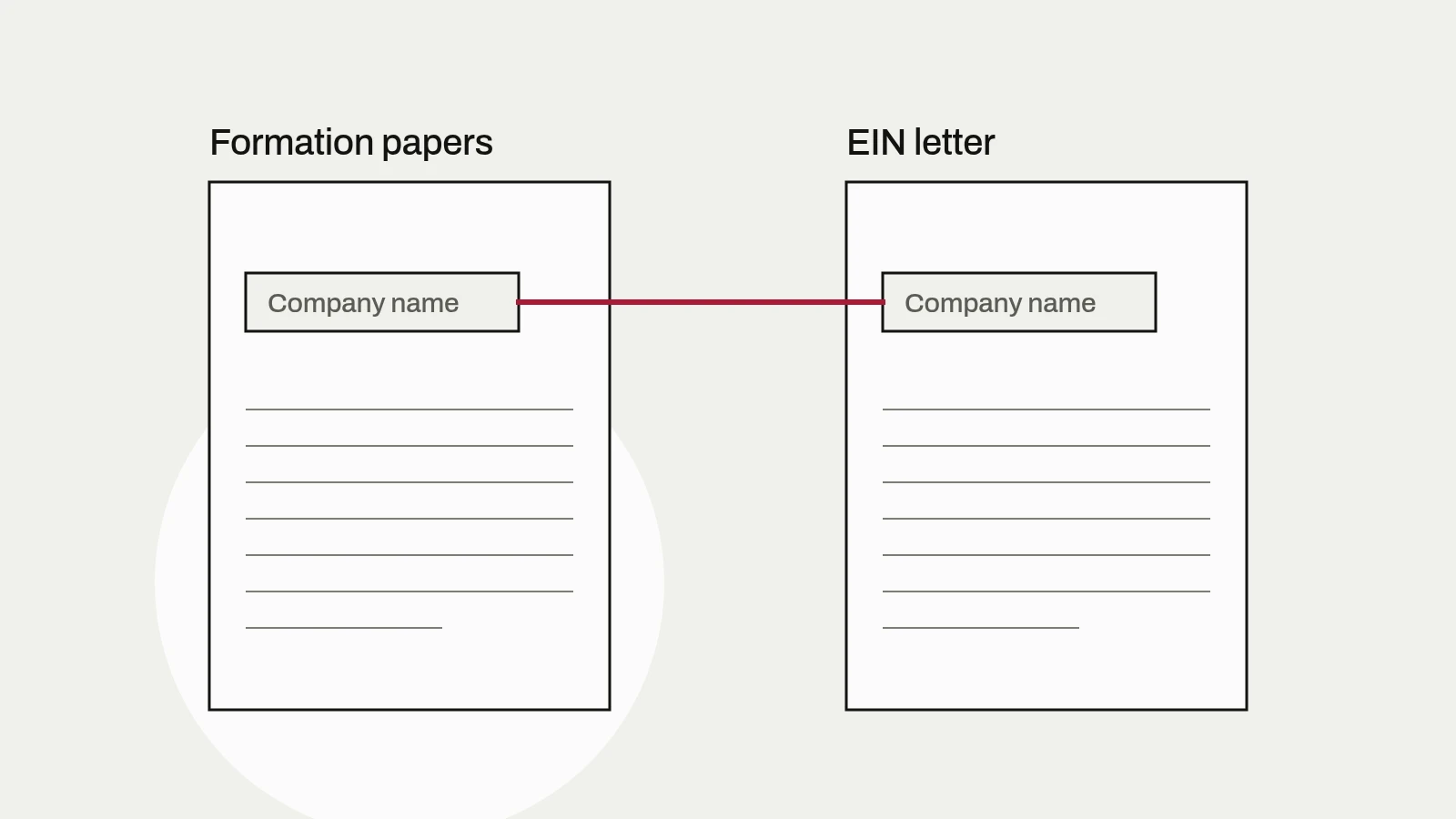
The pattern peers repeat: read the EIN document against your formation papers character by character before you start any bank or processor application. It takes a few minutes and can save weeks in a review queue.
Where it sits in the sequence
In the order most founders describe, the entity exists first, the EIN comes next, and banking comes after that. People who applied for an EIN before the state approved the final company name sometimes created the very mismatch they later had to unwind.
For more on the formation side, Forming a US company from abroad covers what peers sequence before the EIN. For the bank side, US business banking for international founders covers the rest of the document pack banks tend to request.
Where peers keep the letter
Founders who settled in smoothly usually treat company paper as its own track, separate from personal landing and from money movement. The EIN document belongs with the formation papers and governance documents, in a company folder that isn't mixed in with lease PDFs and passport scans.
Peers keep a clean digital copy and know where the original is. Some also note how and when they applied, because that context helps if they ever request a verification letter. Processors, banks, and investors can ask for the document again long after formation.
When we stop talking
Peer notes run out quickly on this topic. Bring in licensed help when any of these come up:
- Tax classification and elections. How your entity is taxed, whether any election makes sense, and what reporting applies to a foreign-owned company. A CPA with cross-border experience is the right seat for this.
- Responsible party questions. Who should be listed, what happens when that person changes, and how to correct the record.
- Correcting a name or record mismatch with the IRS, especially when a bank or investor is waiting on it.
- Complex ownership. A parent company abroad, founders in several countries, investors, or nominee arrangements. That is corporate counsel territory before anything gets filed.
- Status questions. What your visa allows you to do inside the company is a question for immigration counsel.
Soft next steps
Come to the next IFN meetup with one concrete EIN or banking question: a letter you can't find, a name that doesn't quite match, or a bank request you don't understand. Guests are welcome; register on Luma or check dates on ifn.community. If you want the private member channel and members-only call, Become a member. Fuller company paperwork notes and banking prep live with membership and the Resources hub as that catalog fills in.